As cloud-first dominates, Microsoft's perpetual-licence Office 2019 remains the pragmatic choice for buyers who value stability, offline independence, and predictable costs.
The 2026 Office Landscape: Cloud Ascendant, But Not Universal
By mid-2026, Microsoft 365's subscription model has become the default for enterprise and many SMBs. Yet a significant cohort of professionals—particularly in regulated industries, remote-first teams with unreliable connectivity, and organisations with long-term IT budgets—continues to weigh perpetual licences against monthly commitments. The shift toward AI-assisted productivity (Copilot integration, intelligent summarisation) has largely favoured the subscription tier, but that doesn't mean standalone Office 2019 has lost relevance.
The broader trend is telling: organisations are fragmenting. Some teams live entirely in Microsoft 365; others run hybrid stacks mixing legacy Office, Google Workspace, and cloud-native tools. For buyers evaluating PC productivity suites in 2026, the question is no longer "cloud or desktop," but rather "which licence model fits my workflow, compliance posture, and budget horizon."
What's Changed Since 2025: Stability Over Innovation
Office 2019 hasn't evolved—that's the point. While Microsoft 365 subscribers received dozens of feature updates, AI-powered search, and real-time collaboration enhancements throughout 2025–2026, Office 2019 users received security patches and compatibility fixes. For many, this is a feature, not a bug.
The compliance landscape has tightened. NIS2 in the EU, SOC 2 audits across North America, and stricter data residency rules in Australia and Canada have made IT departments more cautious about cloud-first mandates. A perpetual-licence product installed locally, with no mandatory cloud sync, appeals to security-conscious teams. Office 2019's offline-first architecture means no dependency on Microsoft's cloud infrastructure, no surprise policy changes, and straightforward audit trails.
Meanwhile, the total cost of ownership (TCO) calculus has shifted slightly. Three-year Microsoft 365 subscriptions for Home & Business now cost considerably more than a one-time Office 2019 purchase, especially for small teams or individual contributors who don't need collaboration features or Copilot.
What Serious Buyers Should Evaluate in Mid-2026
If you're considering Office 2019 in 2026, ask yourself:
- Offline workflow. Do you work in environments with spotty internet, or do you require zero cloud dependency for compliance reasons?
- Feature requirements. Word, Excel, PowerPoint, and Outlook in Office 2019 are mature and stable. You won't get Copilot, real-time co-authoring, or the latest AI summarisation—but you will get reliable, familiar tools that work predictably.
- Budget model. A perpetual licence means no recurring subscription; you own the software outright. For individuals and small businesses, this can be significantly cheaper over a five-year window.
- Support horizon. Microsoft ended mainstream support for Office 2019 in October 2023, but extended support continues until October 2025 (note: as of June 2026, you're in extended support's final months). Security patches are still issued, but the product is in wind-down mode.
- Integration needs. If your stack relies heavily on Microsoft Teams, OneDrive, SharePoint, or Microsoft Graph integrations, Office 2019 will feel isolated. Subscription-based 365 is the better fit.
Where Office 2019 Fits in the 2026 Portfolio
Microsoft 365 is the company's strategic focus, and rightly so—it's where innovation, AI, and collaborative features live. But Office 2019 remains a solid, no-nonsense productivity suite for a specific buyer: the individual professional, the small team with local-first workflows, the regulated organisation that can't rely on cloud-first architecture, or the budget-conscious user who doesn't need subscription lock-in.
In 2026, choosing Office 2019 isn't about rejecting the cloud—it's about choosing when, where, and how you connect to it.Think of it as the automotive equivalent: Microsoft 365 is the connected car with over-the-air updates and autonomous features. Office 2019 is the well-engineered sedan with no dependency on manufacturers' servers—reliable, fully owned, and happily offline.
The Bottom Line
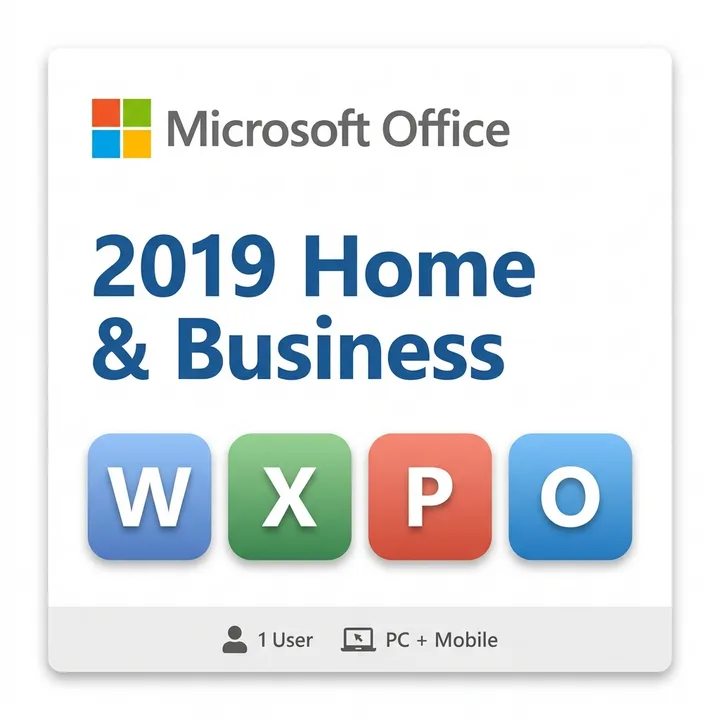
Office 2019 Home & Business for PC is not the future of productivity. It's a pragmatic present for buyers who value independence, predictability, and straightforward licensing. In a market increasingly dominated by subscriptions and AI-assisted tools, its appeal is narrower than it was five years ago—but it's not zero. If your workflow aligns with its strengths (offline-first, no cloud requirement, stable feature set, one-time purchase), it remains a sound choice in mid-2026.
For those ready to evaluate, compare Office 2019 against your actual needs: Do you need the latest AI features and real-time collaboration, or do you need reliable, offline-capable productivity software? Your answer will guide you. Explore the full Office 2019 PC suite, or dive straight into Microsoft Office 2019 Home & Business to see if it fits your toolkit.